Patent Pending Technology  ·  model-surgery.com

Transplant Knowledge.
Not Weights.

We built the surgical toolkit for AI knowledge transfer. Extract any capability from any foundation model and implant it precisely into any other — with zero retraining, zero GPU cost, and verified 91.7% alignment.

Request Early Access → See How It Works
143
Tests Passing
91.7%
Transplant Alignment
<1s
Concept Map Time
$0
GPU Cost to Transplant
Scroll
The Problem We Solved

We Changed the Economics
of AI Development.

For years, teams had two choices when they needed a new AI capability: retrain from scratch, or distill. Both cost a fortune. Both take months. We built the third option — and it costs nothing.

The Old Way

Retrain. Distill. Wait.

  • $50,000–$500,000 per training run
  • Weeks to months of wall-clock time
  • Entire ML teams required
  • Catastrophic forgetting risk
  • Everything changes — precision impossible
  • Cannot transfer a single capability
Average cost: $200,000+
The Model Surgery Way

Map. Align. Transplant.

  • $0 GPU cost — standard hardware only
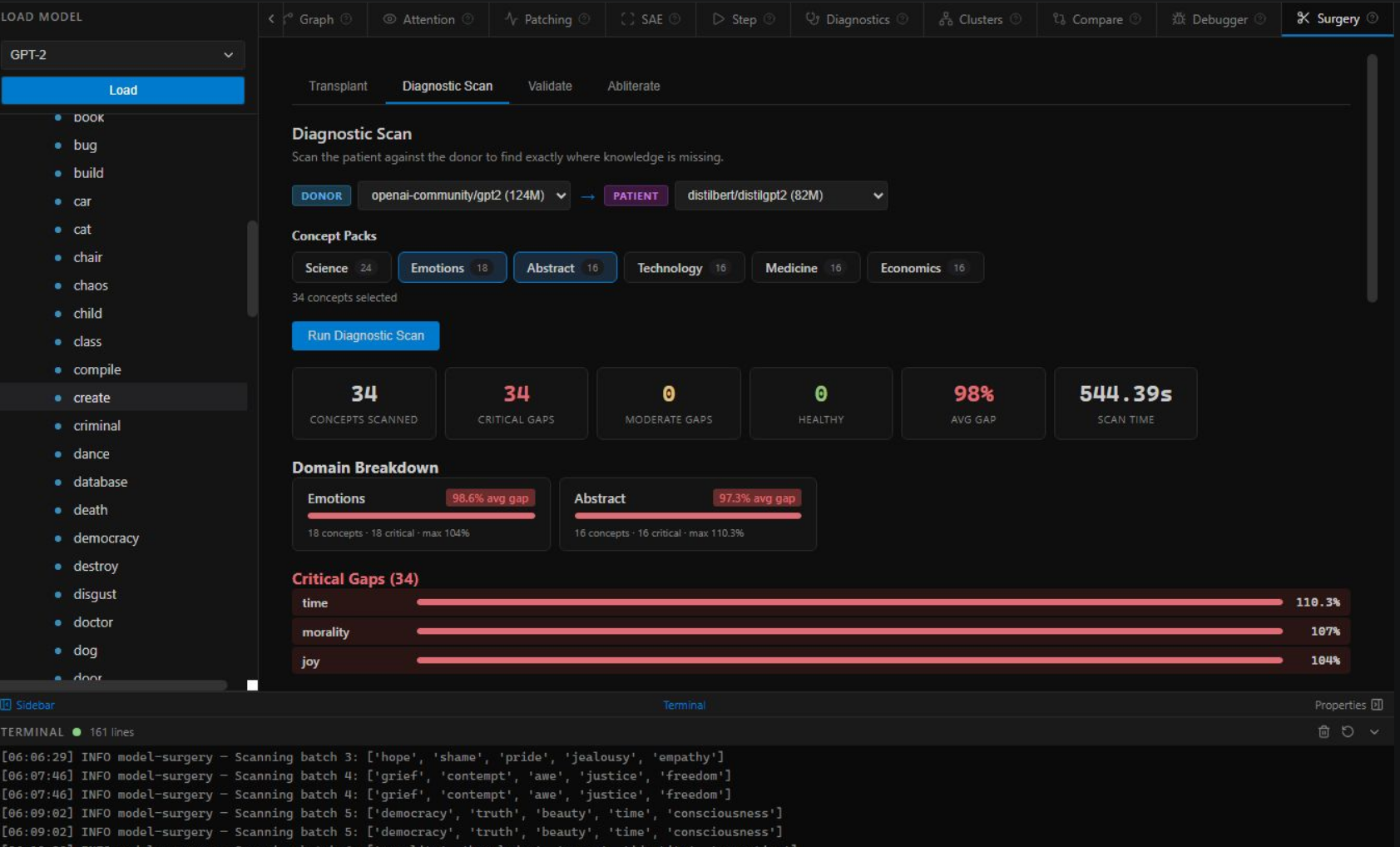
  • Concept fingerprinted in under 1 second
  • Single API call to transplant
  • Interference detection prevents damage
  • Surgical precision — one concept at a time
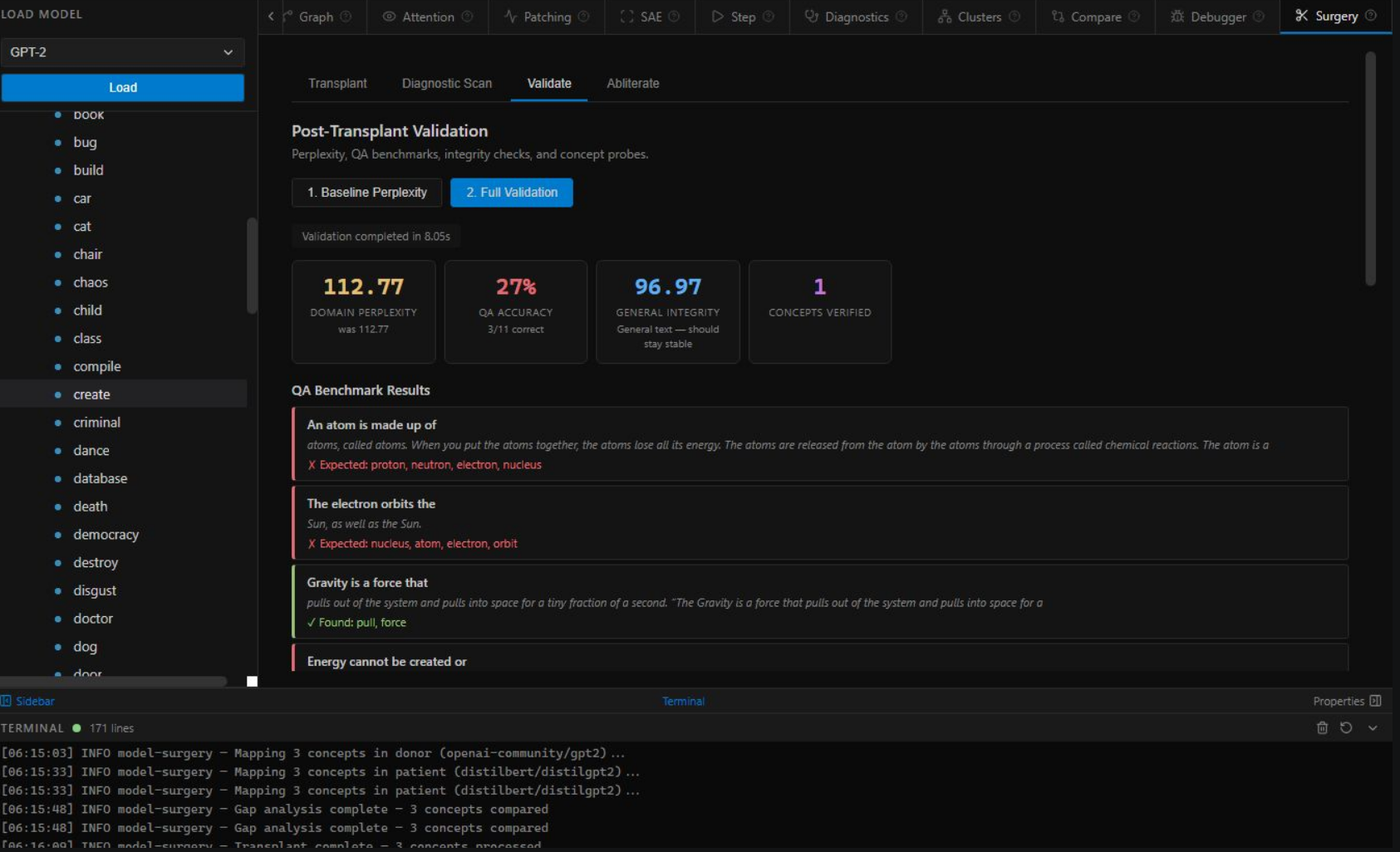
  • 91.7% verified post-graft alignment
Average cost: $0

The Methodology

Three Breakthroughs.
One Surgery.

Our 12-stage pipeline distils to three novel scientific contributions — each independently publishable, together forming the first complete system for cross-model knowledge transplantation.

1

Gradient-SVD Concept Mapping

Every concept has a precise mathematical address inside a model's weight space. We compute it in under one second using a novel gradient-decomposition technique — producing a rank-k fingerprint that uniquely identifies where and how any piece of knowledge is stored. No training required.

2

Layerwise Orthogonal Alignment

GPT-2 and LLaMA store the same concept in different coordinate systems. We solve the orthogonal Procrustes problem independently at each network depth — computing the exact rotation matrix between any two models' internal geometries. Residuals approach zero at all layers.

3

Rank-K Conjugation Transplant

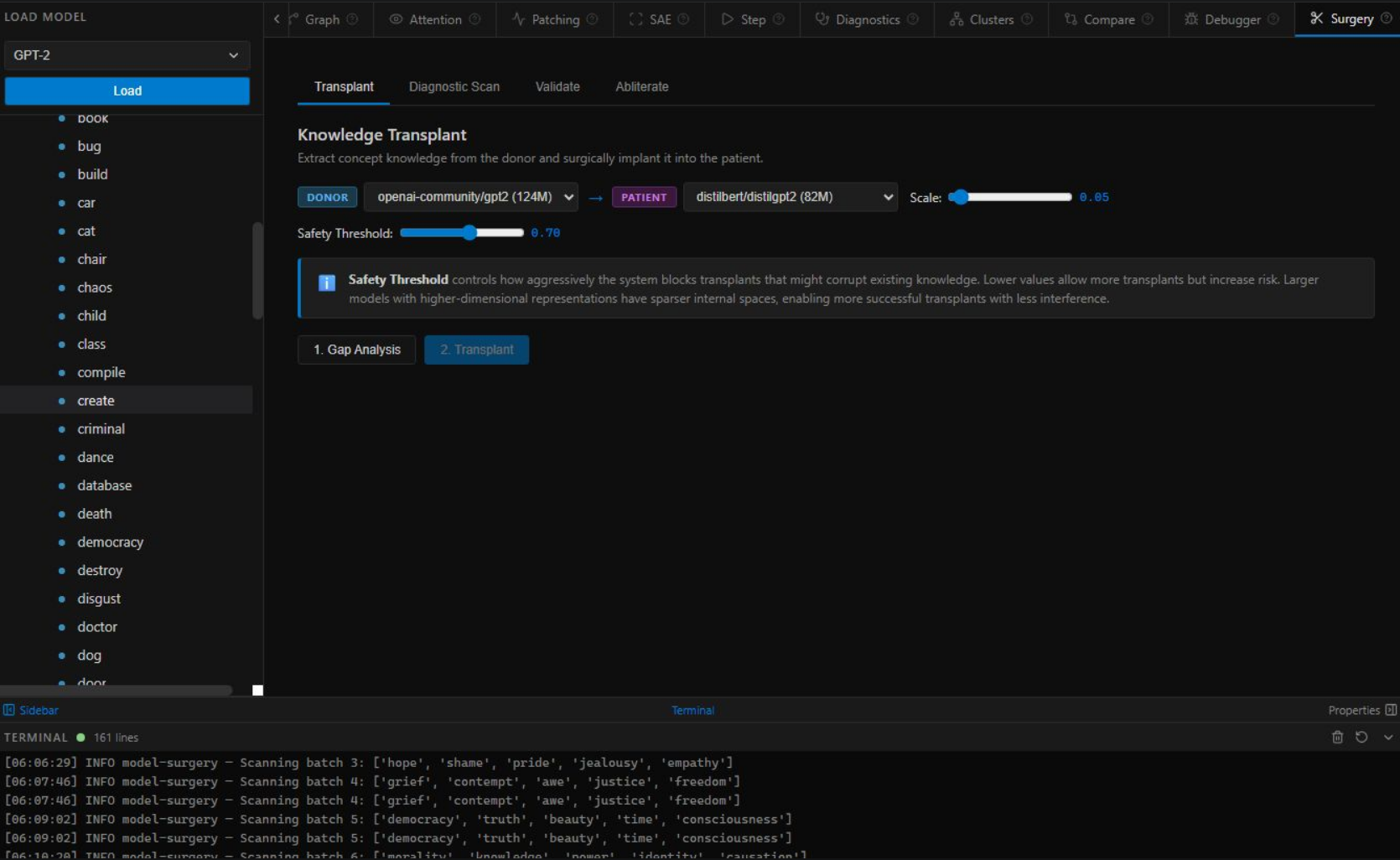
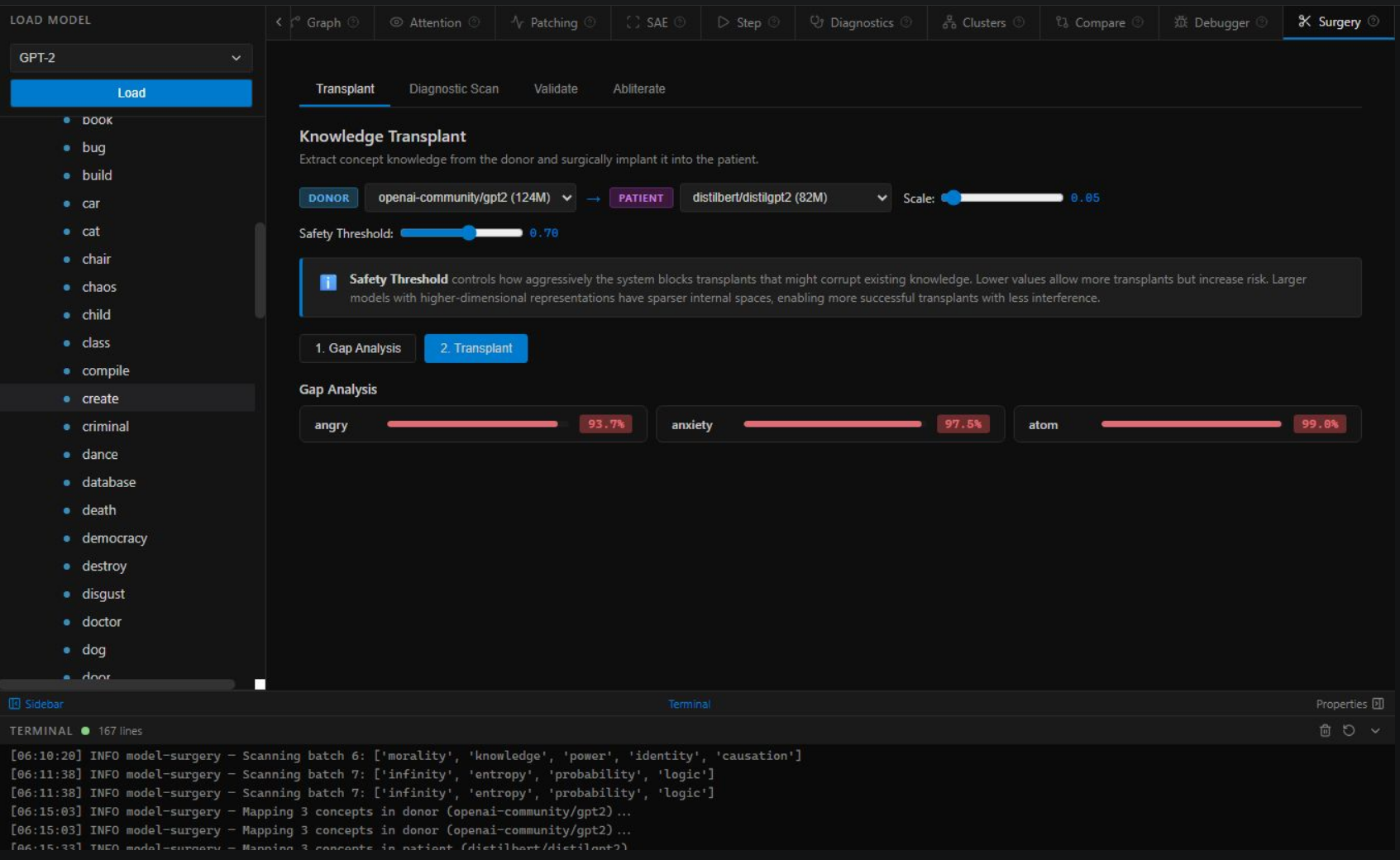
We write knowledge directly into model weights via rank-k conjugation: RTΔR — where R is the Procrustes rotation and Δ is the concept delta. Before any edit, interference detection scans for concept collisions. After surgery, an independent probe verifies the graft took at 91.7% alignment.

$0
GPU cost to transplant any capability
91.7%
Verified alignment on real models post-surgery
≈100%
Procrustes alignment quality across all depth layers
143/143
Tests passing, all 12 pipeline stages

The Infrastructure

12 Stages. Every Step Proven.

From loading any HuggingFace model to verified post-graft alignment — every stage built, tested, and passing. No black boxes.

Stage 01
Load
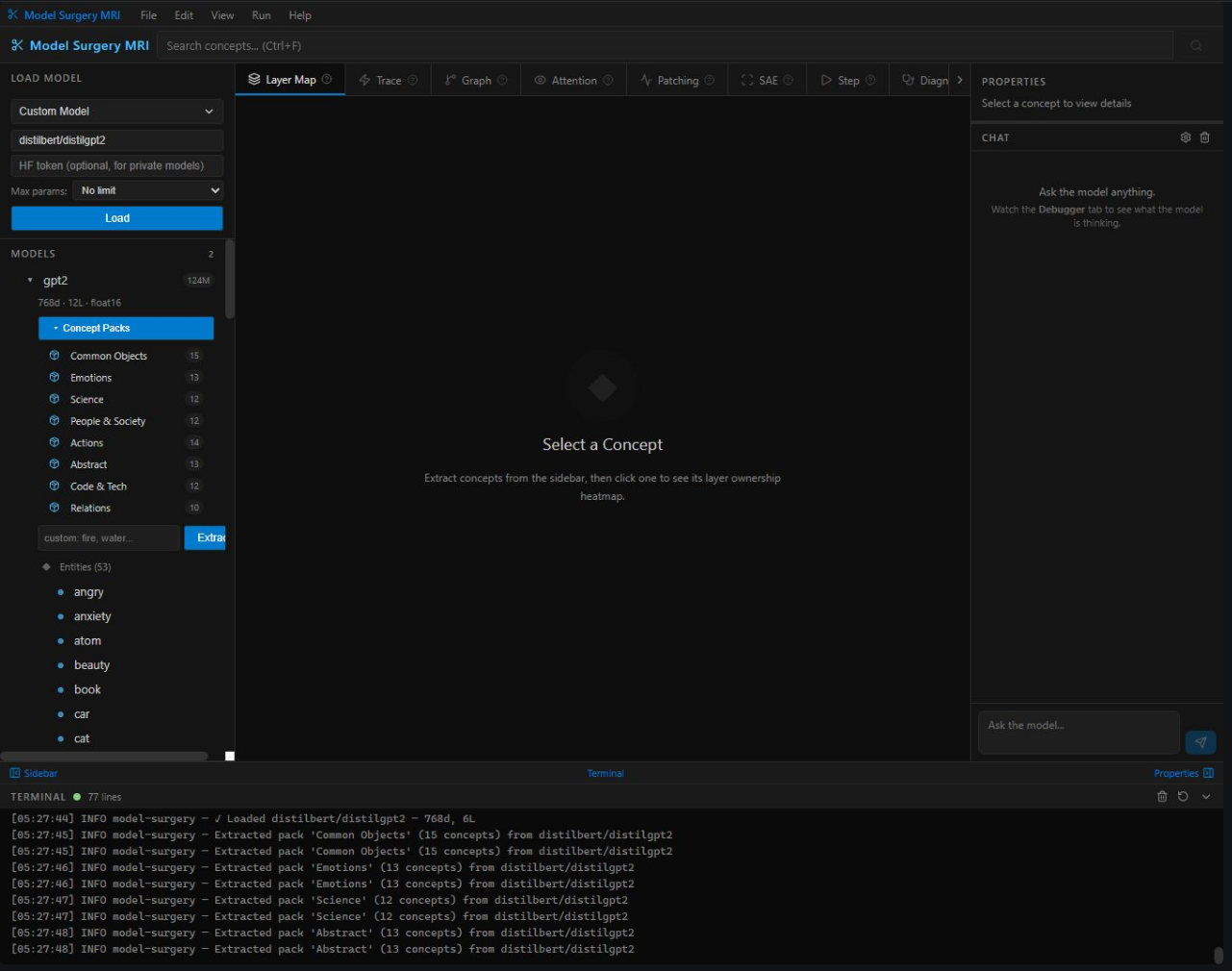
Auto-detect architecture, hardware, optional quantization
Stage 02
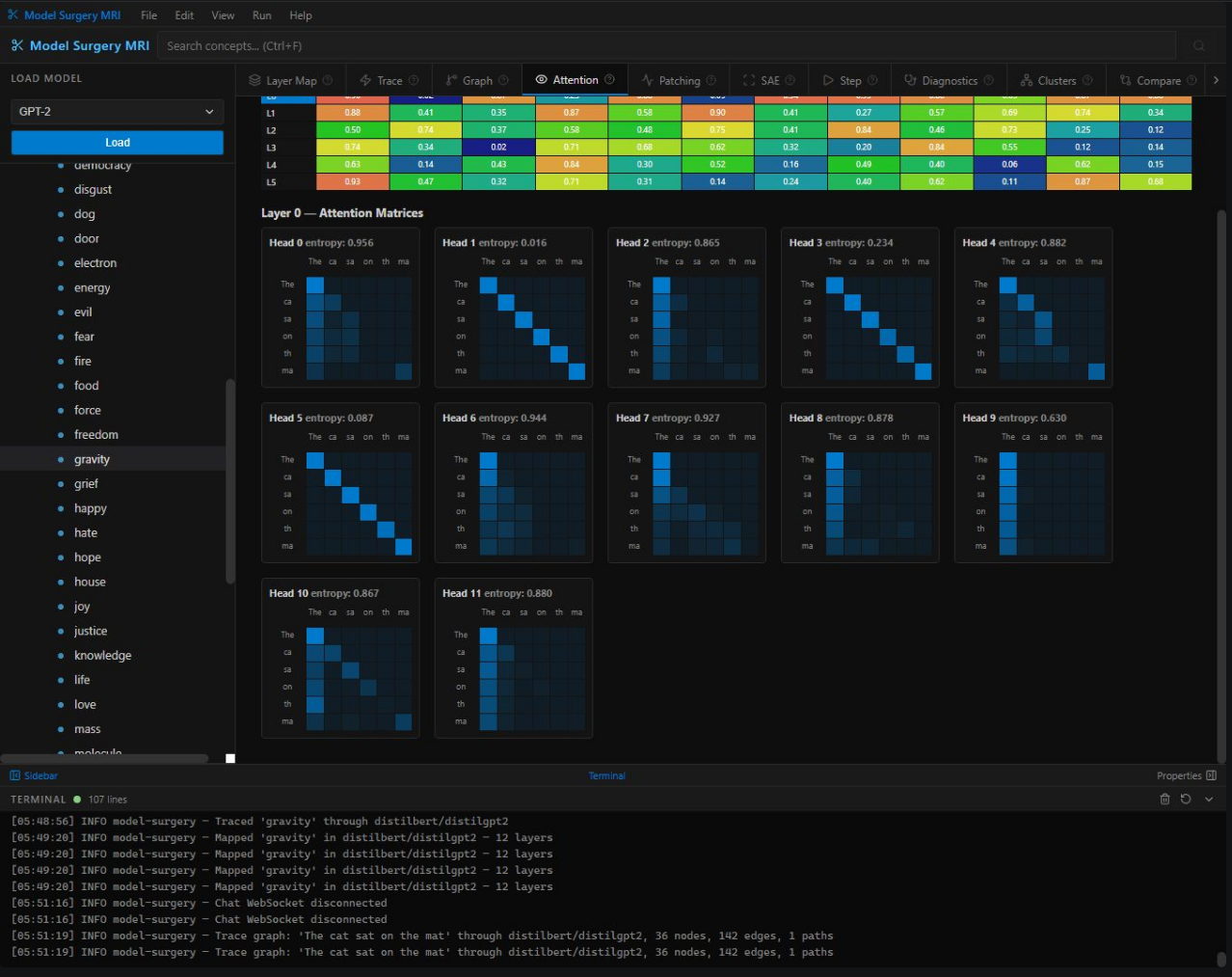
Map
Layer count, hidden dims, attention heads, MLP topology
Stage 03
Extract
Concept vectors via activation hooks — entities, relations, attributes
Stage 04
Cluster
Semantic similarity map — concept neighborhoods
Stage 05
Blueprint
Serialize complete knowledge geometry to JSON
Stage 06
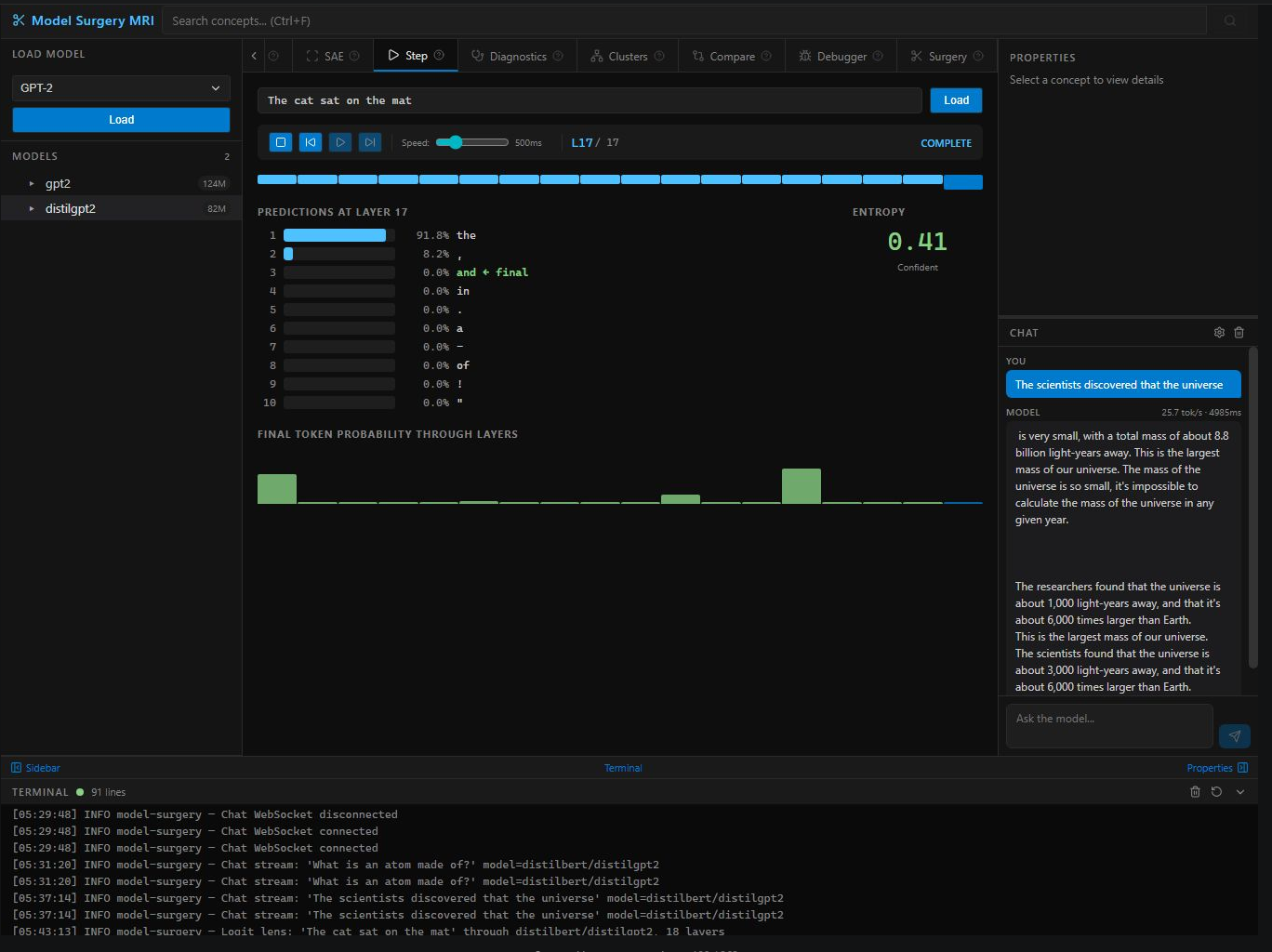
Trace
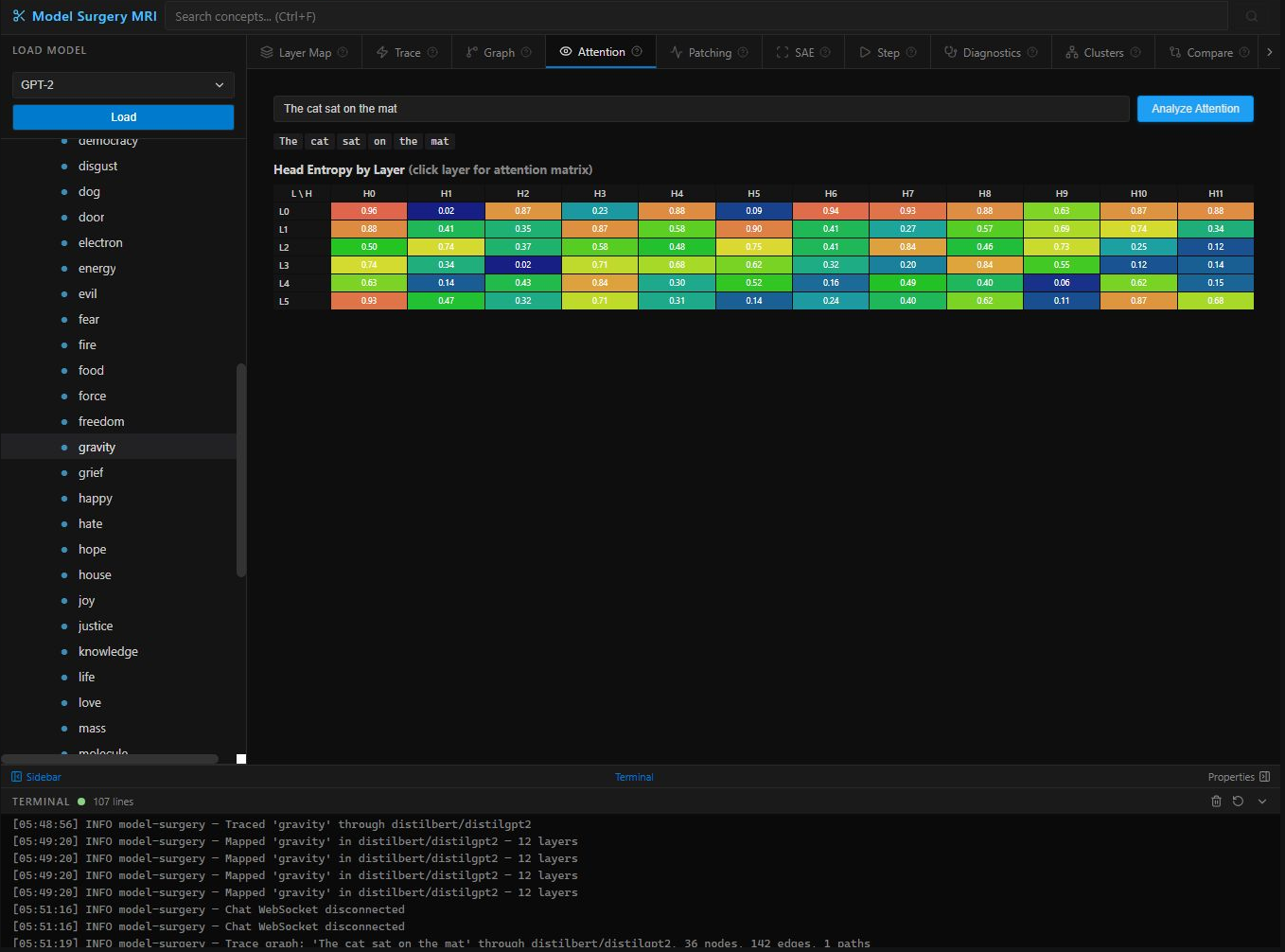
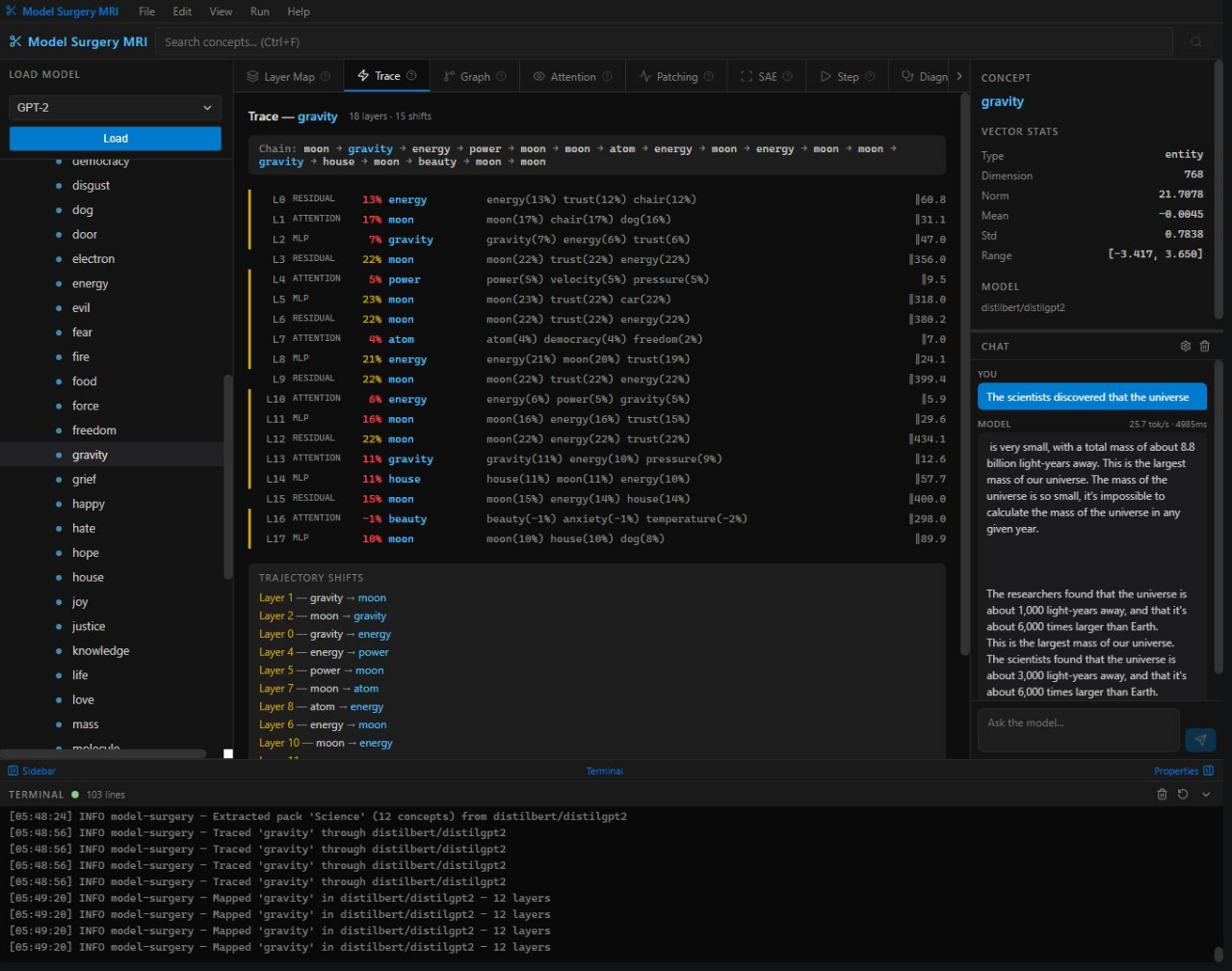
Track how concepts transform layer-by-layer
Stage 07
SAE
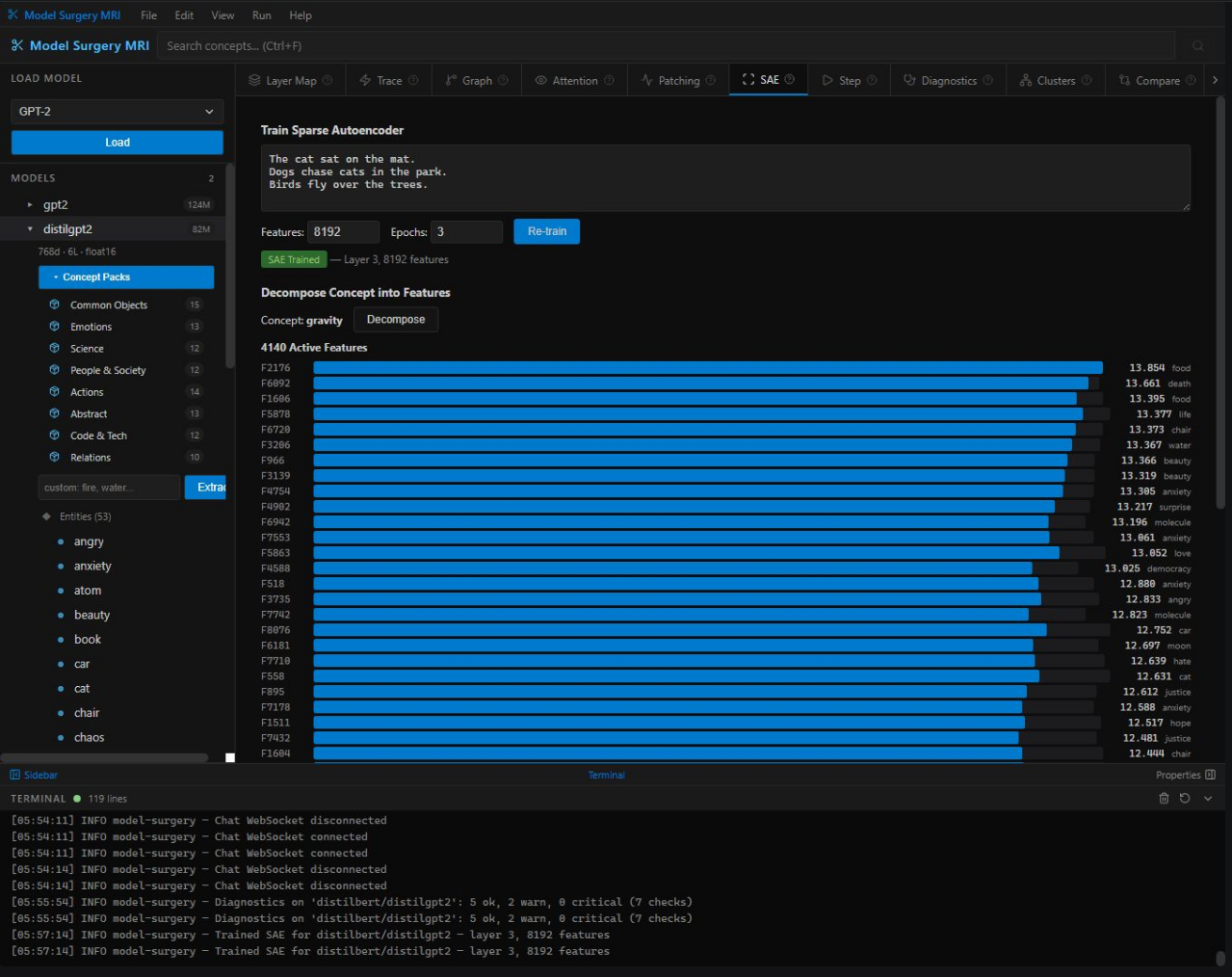
Sparse autoencoder: polysemantic neuron decomposition
Stage 08
Dead Zones
Identify causal layers — minimum cut surgery targets
Stage 09
Visualize
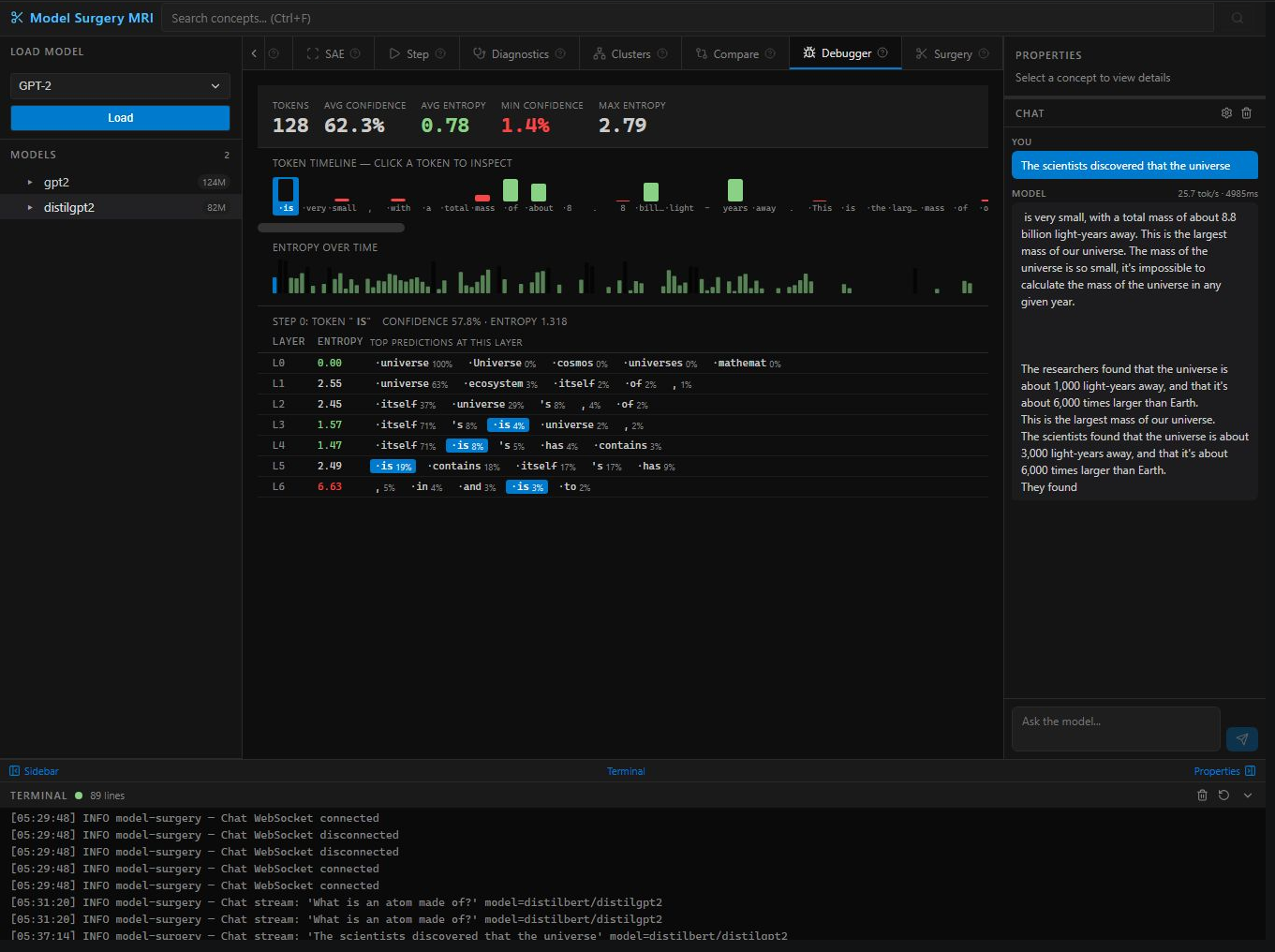
Interactive HTML knowledge map — anatomy made visible
Stage 10
Cartography
LoRA-based fingerprinting with rank-k SVD per layer
Stage 11
Alignment
Cross-model rotation via orthogonal Procrustes problem
Stage 12
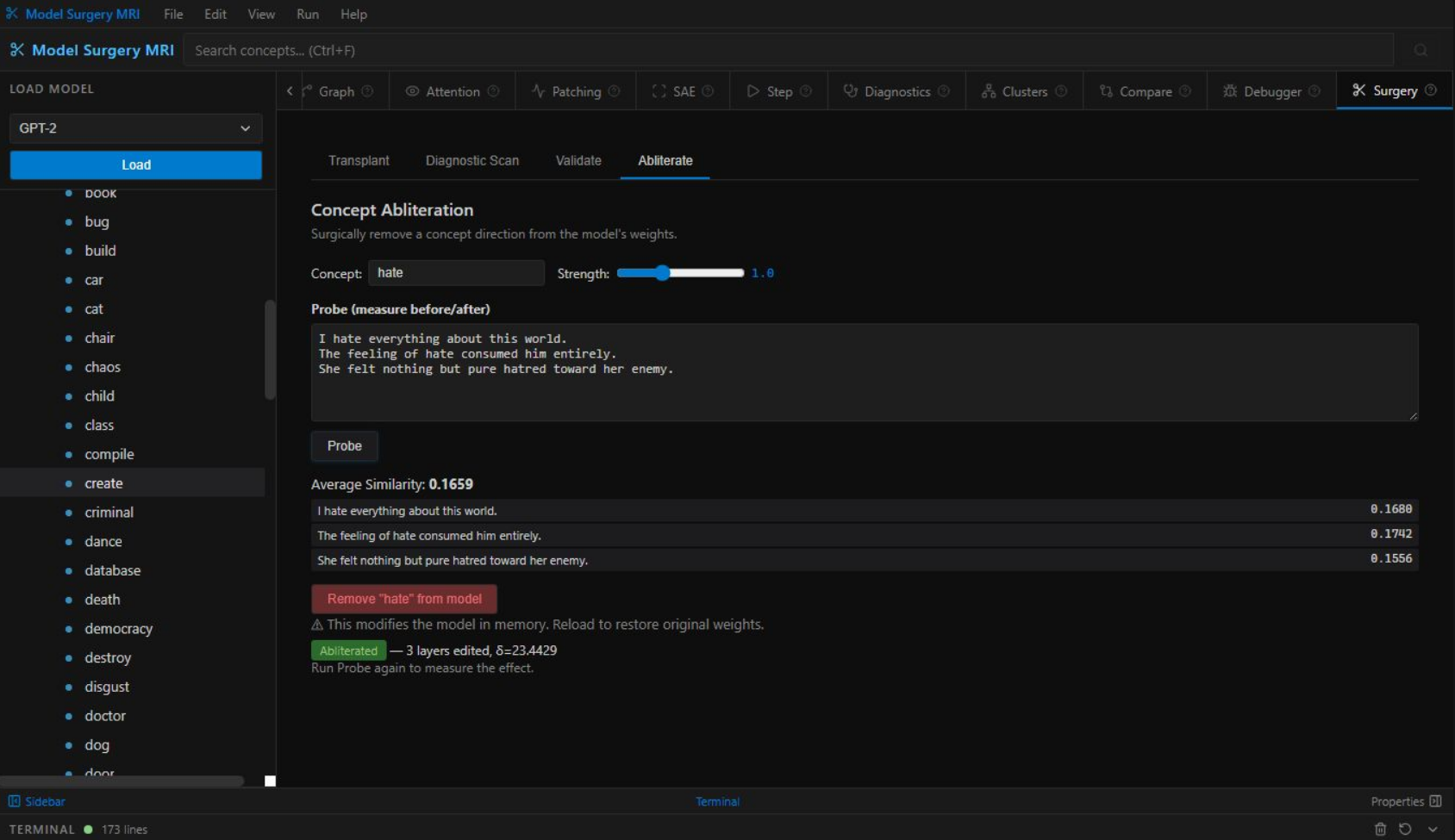
Surgery
Rank-k transplant · interference check · graft verification

Standing on Giants

Grounded in Peer-Reviewed Science.

Model Surgery builds on, extends, and in some areas supersedes the best existing work in neural editing and mechanistic interpretability. We are transparent about our intellectual lineage.

Prior Art · Model Editing

ROME: Locating and Editing Factual Associations in GPT

Meng et al., 2022. Proved facts can be located and surgically edited in transformer weights. We generalize this to arbitrary capabilities.

Read Paper →
Prior Art · Adapter Methods

LoRA: Low-Rank Adaptation of Large Language Models

Hu et al., 2021. The adapter architecture we repurpose for concept fingerprinting — used to extract geometry, not to fine-tune.

Read Paper →
Prior Art · Mass Editing

MEMIT: Mass-Editing Memory in a Transformer

Meng et al., 2022. Extended ROME to simultaneous multi-edits. We extend this concept to full capability transplantation.

Read Paper →
Prior Art · Cross-Lingual Alignment

MUSE: Multilingual Unsupervised Embeddings

Conneau et al., 2018. Showed that embedding spaces align across languages — directly validating our cross-model Procrustes approach.

Read Paper →

Why This Matters

This Changes the Economics
of AI — For Everyone.

"Training a 7B model costs $500,000. With Model Surgery, transplanting that capability costs $0. For the first time in history, AI capability is not a function of how much money you spent training it."

Language Equity

Extract French fluency from a 70B multilingual model and transplant it into a 7B English model. No bilingual data. No fine-tuning. The geometry transfers — verified.

Enterprise Savings

Companies spending millions on domain-specific model training can instead surgically transplant domain knowledge. A single procedure replaces months of training expense.

Scientific Transparency

For the first time: observe exactly where knowledge lives in neural networks, compare locations across architectures, verify transfers mechanistically. A microscope for AI.

Speed to Market

From "we need this capability" to deployed in minutes, not months. Small teams now move faster than companies with 100× their budget.

$500M+

Estimated annual industry savings once teams replace retraining with Model Surgery

Early Access

Be First to Transplant
Neural Knowledge.

Model Surgery is in private research beta. We are onboarding a select group of teams who want to reshape the economics of their AI development.

Patent pending. By requesting access you agree to our research terms.  ·  research@model-surgery.com